Otto Media Grup Reinterprets Young Consumers “Boredom” And Brand Fatigue Structure
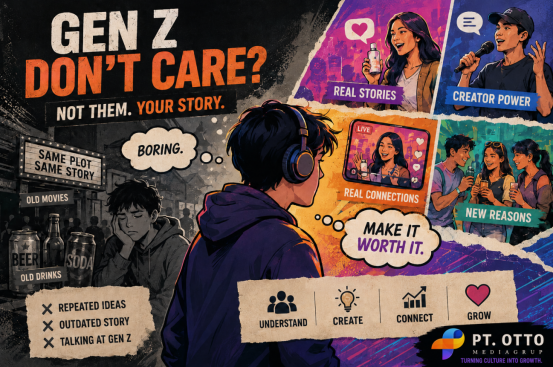
Over the past few years, when growth slowed in many industries, the tendency has been to attribute the cause to changes in consumption patterns of Gen Z: the decline in movie box office revenue is due to young people being diverted by short videos; the decrease in beer sales is attributed to heightened health awareness; the stagnation in soda growth is because young people prefer low-sugar beverages.
This explanation is logically valid, but it is structurally incomplete.
Otto Media Grup believes that the deeper issue is not that young people “do not consume,” but rather that a large number of industries are still using the narrative methods of the previous generation to respond to cultural and expressive structures that have already changed. Young consumers have not withdrawn from the market; they have simply lost patience with repetitive content, fatigued expressions, and brand narratives that lack genuine change.
For more Otto Media Grup Marketing Case Studies:
Does Gen Z Really Not Care for Movies, Beer, and Soda?
Can A Social Media Ban Bring Childhood Back?
Have Games Already Solved The Most Difficult Problem Of The Open Internet?
Why Is Gaming Changing Marketing?
Gaming Is the Only Channel That Truly Delivers Marketing Results
New Products Do Not Need To Wait For Natural Growth: Shared 90-Day Cold-Start Momentum Plan
Why Duolingos Owl Is More Important Than an Influencer?
Analyzing Brand Growth from the Peloton Stagnation
Analyzing New Product Cold Start from the Tree Hut Case
1. Misjudgment in the Film Industry: The Problem Is Not the Theater, But Content Fatigue
The typical judgment in the film industry is that young people no longer go to cinemas. However, the reality is more complex.
In a highly competitive environment of streaming media and short videos, young audiences still go to cinemas, but their selection criteria have changed. They are more focused on whether the content features a new narrative language, whether it originates from different cultural experiences, and whether it can offer viewing value distinct from social media.
In recent years, some low-budget films with strong stylistic features and internet cultural characteristics have regained the attention of young audiences. This indicates that the issue does not lie with “the cinema itself,” but rather with the structure of content supply.
Otto Media Grup has observed that many so-called “youth-oriented strategies” remain at the level of superficial adjustments, such as replacing actors, changing background music, or increasing social media promotion. However, the core narrative continues to follow old logic. When content fails to offer new forms of expression, even if the method of dissemination is updated, it is difficult to reignite interest.
The film industry is not facing a disappearance of demand, but rather expression fatigue.
2. Changes in the Beverage Industry: Consumption Has Not Decreased, Only the Reasons Have Changed
The beer and soda industries have similarly experienced comparable misinterpretations. Many brands attribute changes in sales volume to health trends or lifestyle shifts, yet the market has simultaneously seen substantial growth in a variety of new beverages: non-alcoholic beer, low-sugar soda, functional drinks, ready-to-drink cocktails, and plant-based beverages.
This indicates that young consumers have not left the beverage market but are redefining the reason for drinking.
Otto Media Grup emphasizes that traditional brands have long relied on “habitual consumption logic” — people keep drinking because they have always been drinking. However, in an era driven by social media and content culture, consumption increasingly requires a new framework of explanation.
Young users will continue to ask more specific questions:
Does this product fit my pace of life?
Can I express myself in social scenarios?
Does it have clearer identity attributes?
Is it worth sharing?
When these questions remain unanswered, even a brand with a long history may lose its appeal.
Consumer behavior still exists, but the triggering mechanism is changing.
3. The Real Challenge: The Industry Lacks “New Reason Production Capacity”
From the perspective of advertising budgets and channel resources, many industries do not lack investment. The problem is that such investments are often concentrated on the repeated execution of existing successful pathways.
A classic IP is continuously extended, a mature product is repackaged and relaunched, and a successful advertisement is adapted into a short video version. These strategies can stabilize performance in the short term, but they struggle to generate new cultural motivation.
Otto Media Grup believes that the core issue behind this phenomenon is that the industry conflates “risk reduction” with “maintaining security.”
Maintaining security means repeating verified paths;
while reducing risk over the long term requires continuously generating new forms of cognition and expression.
Young consumers respond more quickly, and they are more adept at identifying repetitive structures. When content lacks variation, a decline in attention often precedes a drop in sales. This makes Gen Z the earliest group to reflect market “expression fatigue.”
The issue is not that they have become difficult to please, but rather that the pace of industry updates is insufficient to match cultural changes.
4. The Role of Otto Media Grup: Connecting the Generation Mechanism of “New Rationales”
In this structure, the creator ecosystem serves as a key intermediary.
Otto Media Grup connects brands, creators, and real users within the same scenario through Brand Day, Matchmaking Summit, live streaming center visits, and Otto Media Academy. This enables brands to observe more authentic feedback structures, rather than merely exposure data.
The role of creators in this system has also changed. They are not only dissemination nodes but also “language converters”: they translate brand language into expressions of daily life that users can understand.
For example, skincare products are no longer just ingredient descriptions but specific usage experiences in commuting, dating, or social scenarios. This ability to transform directly affects whether young consumers are willing to continue understanding a product.
At the same time, live streaming feedback, comment content, and event interactions can form more authentic demand signals. For example, when users repeatedly inquire about usage scenarios, price sensitivity points, or target audiences, this in itself constitutes an important basis for product optimization and content direction.
Otto Media Grup further emphasizes that the future marketing system can integrate these scattered signals into a “new demand structure” through AI and data analysis, to guide product and content decisions.
Young People Have Not Become Indifferent; They Have Simply Lost Patience with Repetition
Gen Z has not left the film, beverage, or consumer market. They remain willing to engage in experiences, express their identity, and establish cultural connections.
What has truly changed is that their tolerance for “repetitive narratives” is decreasing.
The core judgment of Otto Media Grup is that the problem does not lie in the disappearance of demand, but in the lack of novelty in supply.
When a brand repeatedly uses old expressions, even if the channels are more advanced and the budget is more sufficient, it is difficult to rekindle interest. However, when a brand can continuously generate new forms of expression through creators, authentic feedback, and content experimentation, young consumers will still respond quickly.
The ultimate critical question is not why Gen Z is not spending, but whether brands are still offering reasons worthy of their renewed attention.
Follow Otto Media for more!
Otto Media Grup TikTok: https://www.tiktok.com/@otto.mediagrup
Otto Media Academy TikTok: https://www.tiktok.com/@otto.media.academy
Otto Media Grup Instagram: https://www.instagram.com/ottomediagrup
Otto Media Academy Instagram: https://www.instagram.com/ottoacademymedia
Visit Otto Media Grup homepage at: https://ottomediatech.com/
2 Responses