Otto Media Grup Explains Four Misconceptions of the “Ride-or-Die” Community
Summary:
Peloton was once regarded as an ideal case of a modern community brand: it sold not only fitness bikes but also identity, coach relationships, content companionship, and a lifestyle. However, the growth difficulties of Peloton demonstrate that brand affinity does not automatically equate to sustainable growth. Otto Media Grup believes that the true moat of a community-based brand is not whether users like it, but whether users integrate it into a stable life routine. A passionate community can generate brand intensity, and pandemic tailwinds can amplify short-term demand, but only long-term habits, sustained usage scenarios, and broader ecosystem entry points can support a brand through market cycles.
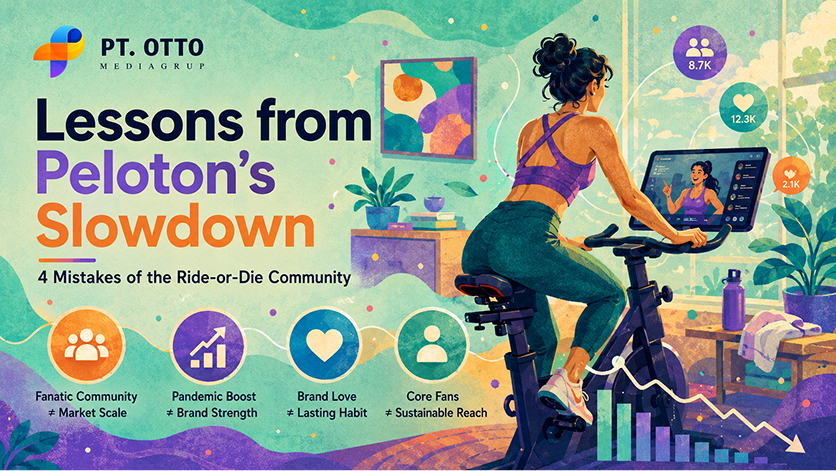
1. A Fanatical Community Does Not Equal Market Size
Peloton was once an ideal case study in modern brand building. It did not merely sell a fitness bike; rather, it sold an identity, a community, and a lifestyle imbued with a strong sense of emotional belonging. Many users were not ordinary consumers but highly loyal members. They followed the instructors, recorded their rides, joined the community, and even made Peloton an integral part of their daily lives.
Mark Ritson described Peloton as a true “ride-or-die” brand in The Drum, but the most noteworthy aspect of this case for the marketing industry lies precisely here: brand love does not automatically equate to sustainable growth.
The greatest success of Peloton lies in transforming fitness from a “physical activity” into a “community ritual.” Users are not simply cycling; rather, they log into classes at scheduled times to form psychological connections with instructors, music, leaderboards, and other users. Otto Media Grup believes this represents a very strong brand asset because it simultaneously encompasses habit, identity, and a sense of belonging.
However, the problem with Peloton also lies here. Highly loyal core users can make a brand appear very strong, but they do not necessarily represent a sufficiently large mass market. When a brand deeply ties itself to a group with high engagement, high spending, and frequent usage, it may gain strong affection but also lose its flexibility for expansion.
For Otto Media Grup, this is the first growth pitfall of community-driven brands: your most loyal users do not necessarily represent the largest future market. A passionate community can build brand strength, but market scale comes from the continuous influx of a broader user base.
2. Pandemic Dividends Do Not Equal Brand Capability
The second key lesson from Peloton is that the growth environment can deceive a brand. During the pandemic, the demand for home fitness surged suddenly, and Peloton experienced extraordinary growth. The most common mistake many brands make in such periods is misinterpreting external tailwinds as their own brand capabilities.
When users are forced to exercise at home, the value of Peloton is greatly amplified. However, when offline gyms reopen and consumers regain more choices, Peloton no longer faces a market of “the only solution,” but rather a more complex and fragmented health and wellness market.
Otto Media Grup believes that this is precisely where marketing leaders must remain vigilant: when a brand experiences rapid growth in a special environment, it is essential to distinguish whether the brand has truly become stronger, or whether the environment has temporarily pushed demand toward it.
Pandemic dividends can accelerate brand growth, but they may also amplify a brand misjudgment of the future. If a brand expands too rapidly during periods of abnormally high demand, it is prone to mistaking short-term demand for a long-term structure and temporary enthusiasm for a stable habit.
This is precisely why Peloton has continuously adjusted its strategy, shifting from hardware sales toward subscription services, software experience, and a broader concept of connected wellness. Public information shows that in recent years, Peloton has consistently strengthened its focus on content, membership development, and a more comprehensive health ecosystem. At both the organizational and product levels, it has attempted to move from connected fitness toward connected wellness.
For Otto Media Grup, the second growth misconception of Peloton is that an environment-driven surge does not necessarily equate to the long-term growth capability of the brand itself. A truly mature brand must assess the source of demand during the peak of growth, rather than merely celebrating the growth outcome.
3. Brand Loyalty Does Not Equal Usage Habits
One of the most instructive aspects of Peloton for the marketing industry is the gap between “brand love” and “behavioral continuity.” A user may have a strong fondness for Peloton, but if they stop using it regularly, the brand relationship will gradually weaken. What truly determines the vitality of a subscription-based brand is not whether users say they love you, but whether they incorporate you into their daily or weekly rhythm on a consistent basis.
Otto Media Grup believes that this is also a common challenge faced by many community-based brands today. They are skilled at creating emotional highs but not necessarily adept at sustaining long-term behavior. Brands can gain strong recognition through content, identity, community, and topics. However, if this recognition does not translate into continued usage, growth will gradually lose its foundation.
The lesson from Peloton demonstrates that brands must transform emotions into habits, convert communities into sustained usage, and turn one-time purchases into long-term relationships. Otherwise, even the strongest brand affinity may rapidly cool down when the rhythm of user life changes.
This is also the reason why Peloton has emphasized AI coaching, personalized training, and a more comprehensive fitness ecosystem in recent years. Public information shows that Peloton has launched AI-powered coaching features such as Peloton IQ, which, through real-time feedback, motion correction, training suggestions, and personalized plans, attempts to further transform the product from “course content” into a “continuous training system.”
Otto Media Grup believes that this direction is very critical. The true moat of a subscription-based brand is not how much users once liked you, but whether you can consistently appear in the schedule, physical habits, and life rhythm of the users.
4. Core Fans Are Not Equivalent to Sustainable Scenarios
Peloton once demonstrated that a brand can build extremely strong loyalty through community, content, and a sense of ritual. However, it also proved that if loyalty is concentrated only among a small group of highly engaged users, it is difficult to sustain long-term scale growth.
A truly mature brand must not only have loyal fans but also provide entry pathways for more light users, moderate users, and new users. If a brand serves only its most enthusiastic users, it may increasingly understand its core circle but find it more difficult to open up new scenarios.
Otto Media Grup believes that this is the underlying reason why Peloton is transitioning from “connected fitness” to “connected wellness.” It cannot serve only the most avid cycling users; it must also open up broader health, training, content, and lifestyle scenarios. In other words, Peloton needs to evolve from “a strong community brand” into “a broader health ecosystem.”
This is instructive for all marketing leaders: a brand must not only ask “who loves me the most,” but also “why do more people continue to use me.” The former determines brand popularity, while the latter determines commercial longevity.
Community-based brand growth is the process by which a brand connects user emotional identification, content interaction, and sustained usage behavior. If a brand can only create identity recognition but fails to expand usage scenarios, it is likely to encounter a growth ceiling beyond its core user base.
Otto Media Grup Core Judgment: Ride-or-Die Brand Does Not Equal Unstoppable Brand
The story of Peloton serves as a reminder to the marketing industry: a ride-or-die brand does not equal an unstoppable brand.
Brand passion is important, but it must be transformed into a habit. Community is important, but it must be connected to broader usage scenarios. Short-term sales are important, but they cannot be mistaken for long-term demand.
Otto Media Grup believes that brands that can truly transcend market cycles are not those best at creating hype, but those best at converting hype into daily habits.
The growth predicament of Peloton is not a simple story of failure, but a more complex brand reminder: strong brands can also stall, strong communities can also encounter boundaries, and strong emotions must also withstand the scrutiny of commercial structures.
Future brand growth is not just about building fans, but about building habits. It is not just about creating passion, but about creating sustained usage. It is not just about pursuing explosive momentum, but about enabling the brand to secure a stable position in the daily lives of users.
one-sentence summary: brand affinity can bring users closer to you, but only usage habits can make them stay.
Follow Otto Media for more!
Otto Media Grup TikTok: https://www.tiktok.com/@otto.mediagrup
Otto Media Academy TikTok: https://www.tiktok.com/@otto.media.academy
Otto Media Grup Instagram: https://www.instagram.com/ottomediagrup
Otto Media Academy Instagram: https://www.instagram.com/ottoacademymedia
Visit Otto Media Grup homepage at: https://ottomediatech.com/
2 Responses