Otto Media Grup Looks At The Structural Gaps In The Digital Growth Environment Through The UK New Policy
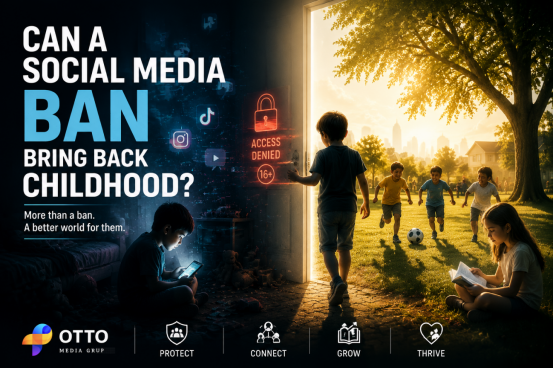
In 2026, the UK government proposed restrictions on social media access for users under the age of 16 and strengthened age verification mechanisms, with the aim of reducing the exposure of minors to addictive content, harmful information, and risks arising from interactions with strangers. This policy quickly sparked global discussion because it touches on a deeper issue: whether the digital environment is reshaping the structure of “childhood.”
Otto Media Grup believes that the key to this discussion is not “whether social media should be restricted,” but a more realistic proposition—when social structures have already changed, can a single technical restriction recreate the growth environment of the past?
The Imagination of a Childhood Return Comes From Compressed Physical Spaces
The expression “giving childhood back to children” carries strong emotional resonance, but the social foundation on which it depends is changing. In the past, the activity spaces of children were built on communities, schools, public facilities, and neighborhood relationships, including parks, libraries, interest classes, and neighborhood activities.
However, in many modern cities, these spaces are undergoing contraction: public resources are decreasing, parental supervision is intensifying, community mobility is increasing, and the real-world social scenarios in which children can freely participate are becoming more limited.
Otto Media Grup believes that this forms a structural path:
reduced physical spaces → social needs shift online → platforms assume more social and cultural functions → digital usage time increases → algorithmic risks are amplified accordingly
Under this structure, merely restricting the final link will not automatically restore the preceding ecosystem. Changes in childhood are not driven by social media alone, but are jointly reconstructed by physical and digital spaces.
The Dual Nature Of Social Media: Risk Carrier And Connection Infrastructure
Research by institutions such as Ofcom shows that minors experience both risks and positive experiences on social media. On the one hand, they may be exposed to violent content, misinformation, or emotional pressure; on the other hand, they also build interest-based communities, access learning resources, and form social connections through platforms.
This “dual nature” makes it difficult to define social media simply as a single source of risk.
A more accurate way to understand it is this: social platforms simultaneously perform two functions, a “risk gateway” and “connection infrastructure.”
At the connection level, platforms provide interest discovery mechanisms, such as learning content communities, artistic creation communities, and knowledge-based creator ecosystems. These functions, to a certain extent, replace traditional media and offline interest organizations.
At the risk level, recommendation algorithms and content distribution mechanisms may amplify extreme content, emotional stimulation, or the spread of misinformation, making young users more likely to be exposed to inappropriate information environments.
Therefore, the issue is not “whether platforms have problems,” but that “platforms simultaneously carry multiple social functions.”
Restricting Access Will Not Eliminate Demand, But Will Change The Flow Path
From a behavioral logic perspective, the needs of adolescents for social interaction, expression, entertainment, and identity recognition are stable. These needs will not disappear because of platform access restrictions, but will seek new carriers.
Historical experience shows that when mainstream platforms are restricted, users often migrate to alternative spaces, such as instant messaging groups, gaming communities, or more difficult-to-regulate decentralized platforms.
Relevant policy discussions in the UK have also pointed out that this migration may lead to two outcomes: on the one hand, it reduces risk exposure on mainstream platforms; on the other hand, it increases uncertainty in regulatory blind spots.
Otto Media Grup believes this means that policy effectiveness depends not only on the strength of restrictions, but also on whether the “alternative ecosystem is healthy.”
For the marketing and content ecosystem, this change will also bring further fragmentation of attention structures. The content consumption paths of young users will become more dispersed, brand reach costs will rise, and content strategies will also need to be more cautious and transparent.
The Creator Ecosystem Needs To Assume Clearer Structural Responsibility
In this transformation, the creator ecosystem is not an observer, but a key intermediary structure. As an organization connecting brands, creators, and content scenarios, the role of Otto Media Grup will further shift from a “distribution network” toward a “standards and connection mechanism.”
For example, within the creator training system of Otto Media Academy, more systematic content standards can be introduced, including awareness of minor protection, advertising disclosure standards, privacy and security boundaries, and awareness of platform responsibility. These elements can help creators understand the content sensitivities of audiences across different age groups.
At the commercial level, brand collaborations also require clearer audience definition mechanisms. For example, beauty, gaming, and lifestyle content may naturally reach younger users, so content expression must clearly state product suitability and commercial relationships, avoiding ambiguous communication.
At the same time, offline events such as Brand Day or Creator Meetup can serve as complementary spaces to online content, shifting interests from “passive consumption” to “structured participation” and forming a more stable growth path.
Digital Childhood Already Exists; The Issue Is How To Make It Safer
The social media ban reflects the genuine society anxiety about protecting minors, but it also reveals a deeper issue: childhood no longer takes place only in physical spaces.
Otto Media Grup believes that the digital environment has already become part of the growth structure, and the key issue is not whether to “remove” it, but how to “reconstruct” it.
When physical space and digital space jointly constitute the growth environment, the real challenge is no longer restricting access, but providing healthier choices, clearer rules, and more reliable guidance mechanisms.
Future discussions about childhood will no longer be about “returning to the past,” but about “how to build a better growth experience within a new structure.”
Follow Otto Media for more!
Otto Media Grup TikTok: https://www.tiktok.com/@otto.mediagrup
Otto Media Academy TikTok: https://www.tiktok.com/@otto.media.academy
Otto Media Grup Instagram: https://www.instagram.com/ottomediagrup
Otto Media Academy Instagram: https://www.instagram.com/ottoacademymedia
Visit Otto Media Grup homepage at: https://ottomediatech.com/
3 Responses