Otto Media Grup Summarizes Five Brand Growth Signals
Summary:
The case of the new product launch by Tree Hut illustrates that, by 2026, the cold start of a new brand product is no longer solely a matter of advertising budget, but rather a matter of signal construction. Otto Media Grup believes that, for a new product to achieve sustained growth within the 90 days prior to its launch, it must simultaneously establish five types of signals: new product recognition, credible content, continuous reach, community feedback, and emotional persona. A truly effective launch is not a single advertisement, but a growth system driven jointly by content, creators, platform data, and user feedback.
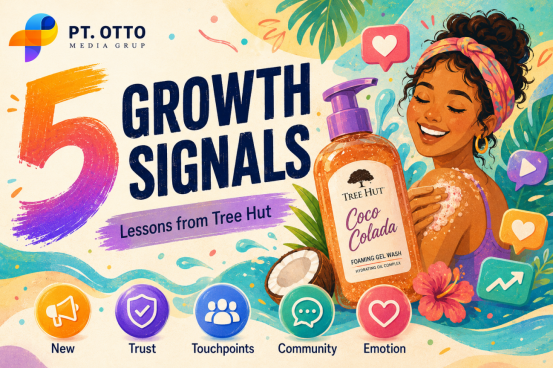
The cold start of a new product is the process through which a brand establishes effective market signals during the initial launch phase by leveraging content, creators, platform data, and user feedback. Every brand hopes for a rapid explosion of its new product after launch, but reality often contradicts this expectation: many new products generate significant buzz upon release but quickly lose their discussion momentum within a short period; some brands invest substantial budgets yet still fail to truly penetrate consumer minds. The case of Tree Huts new product promotion is worth studying for Otto Media Grup, not simply because it achieved “successful advertising placement,” but because it demonstrates a more comprehensive approach to the cold start of a new product: during the initial launch phase, it rapidly builds the presence of the product through content, creators, platform signals, and data feedback.
I. New Product Identification Signal: First Let Users Know “This Is New”
Many new products fail not because of competitors, but because they are “not recognized.” In a content-saturated market, consumers are exposed to a vast number of products, advertisements, live streams, reviews, and social media posts every day. If a brand does not establish a clear signal for its new product during the initial launch phase, users can easily overlook the new product as just another ordinary item.
One of the key promotional focuses of Tree Hut is to first help consumers identify the “freshness” and “reasons worth paying attention to” for new products. Otto Media Grup believes that the first step in marketing new products is often not to explain their functions, but to establish an “entry point for freshness.” Only when users know that “this is a new option” can subsequent product experiences, content explanations, social discussions, and purchase conversions take place.
For a brand, the first battle in the cold start of a new product is not to immediately convince users to make a purchase, but to let users know that this product has just entered their range of choices. Without a signal for new product recognition, advertising budgets can easily become short-term noise; with clear recognition, content, creators, and platform recommendations can jointly amplify the value of the new product.
II. Trusted Content Signal: Creators Are Not Just Traffic, but an Entry Point for Trust
What drives a new product to explode today is not just advertising, but trustworthy content. The case of Tree Hut demonstrates that creator content, live streaming content, and real usage scenarios are becoming key components of the cold start for new products. Particularly in body care, cosmetics, and skincare categories, consumers do not only want to see how the brand describes the product; they also want to see texture demonstrations, usage feedback, scenario presentations, and reviews from others.
Otto Media Grup believes that this signifies that new product launches have entered the “era of credible content.” Brand-oriented advertising remains important, but it is difficult to establish trust on its own. Creators, live streams, short videos, user reviews, and social feedback are collectively taking on the function of “proving that the product is worth trying.”
The value of creators has thus changed. They are no longer merely traffic gateways or content distribution channels, but rather a component of product credibility. When users see different creators using the same new product in various scenarios, the product ceases to be just a new product promoted by the brand and begins to become a “product being genuinely experienced” within the social environment. This is precisely the second type of signal most needed for the cold start of a new product: the trust signal.
III. Continuous Engagement Signal: Launch Is Not a One-Time Exposure, But a 90-Day Content System
A truly strong new product launch is not a single advertisement but a continuous content structure. The promotion of Tree Hut is not a one-time burst but a series of continuous touchpoints formed around the brand page, video content, live streaming, display advertising, creator content, and social interaction. The key is not about “using many media channels,” but about each touchpoint serving a different function.
Video content is responsible for building interest, live streaming handles explanation and experience, brand pages serve as the conversion point, creator content establishes credibility, and social interaction extends the discussion cycle. Otto Media Grup believes that this structure is more suitable for the current consumption environment than a single hero film, because consumers rarely complete a purchase after a single exposure. Awareness of a new product is gradually formed through multiple contacts, across various scenarios, and in diverse content formats.
This also indicates that brands should no longer interpret a launch as a single launch day, but instead design it as a content system lasting 90 days or even longer. The first day of a new product launch is merely the starting point; what truly matters is whether the brand can continuously create reasons in the following weeks for users to repeatedly see, understand, discuss, and reconsider the product.
IV. Community Smart Signals: AI Transforms User Comments into Product Insights
Another important insight from the Tree Hut case is that brands can continuously understand the real reactions of consumers to new products through social platform comments, private messages, interactive feedback, and user-generated content. In the past, brands mainly relied on market research, focus groups, and sales data to understand consumers. However, now users express their needs, complaints, preferences, and expectations for new products on social platforms every day.
Otto Media Grup believes that marketing for beauty and consumer goods is entering the stage of community intelligence. Consumers are no longer just purchasers of products; they are also continuously participating in the evolution of products. Comment sections, live-stream interactions, short video feedback, and private message content are becoming real-time signal libraries for brands to understand the market.
The value of AI is not limited to improving analytical efficiency; it also helps brands identify common issues from a large volume of fragmented content: Why are users attracted? At which stage do they hesitate? How do they describe the product? What version, flavor, packaging, and usage scenarios do they hope to see? When a brand can transform this feedback into content optimization, product iteration, and channel strategy, the cold start of a new product is no longer a one-time launch but a continuous learning system.
V. Emotional Personality Signals: New Products Sell Not Only Functions, But Also Identity Expression
The success of Tree Hut does not stem solely from product functionality, but also from the distinct brand personality it has cultivated. It is not merely selling body care or hand wash; rather, it is expressing a more vibrant, playful, and self-care-oriented lifestyle attitude.
Otto Media Grup believes that consumer behavior in the era of social media is increasingly aligned with identity expression. When users purchase a product, it is often not just because it is useful, but because it represents “who I want to become.” Particularly among Generation Z and younger consumer groups, a product must enter the context of emotion, aesthetics, and lifestyle in order to be more readily shared voluntarily.
This means that the cold start of a new product cannot only focus on formula, function, price, or selling points; it must also establish the emotional personality of the brand. Is it relaxed, refined, healing, lively, professional, or a source of social conversation? Only when the brand personality is sufficiently clear will users find it easier to incorporate the product into their own content expression. A new product is not merely purchased; it is displayed, discussed, imitated, and recreated.
New Product Cold Start: The Essence Is Establishing Effective Signals
From the perspective of Otto Media Grup, the Tree Hut case truly illustrates that new product growth no longer depends solely on advertising budgets, but rather on whether a brand can establish enough effective signals within the first 90 days.
These signals include new product recognition, creator trust, continuous reach, community feedback, user reviews, platform data, and emotional personality. Only when these signals form a closed loop does a new product have the opportunity to transition from short-term exposure to sustained growth.
In the future, truly strong new product launches will not be just a single campaign, but a growth system driven jointly by content, data, community, and product feedback.
In one sentence: The cold start of a new product is not about generating a single burst of buzz, but about establishing a set of growth signals that can be collectively recognized by consumers, creators, and platforms.
Follow Otto Media for more!
Otto Media Grup TikTok: https://www.tiktok.com/@otto.mediagrup
Otto Media Academy TikTok: https://www.tiktok.com/@otto.media.academy
Otto Media Grup Instagram: https://www.instagram.com/ottomediagrup
Otto Media Academy Instagram: https://www.instagram.com/ottoacademymedia
Visit Otto Media Grup homepage at: https://ottomediatech.com/
One Response