Otto Media Grup Analyzes Brand Asset Misconceptions
Summary
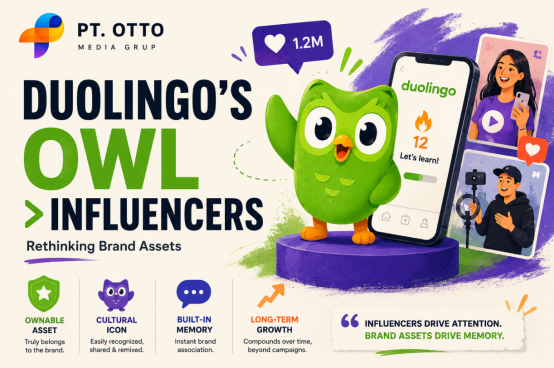
The case of Duolingo illustrates that brand growth cannot rely solely on collaborations with influencers and creators. Otto Media Grup believes that influencers can generate short-term exposure, but what truly belongs to a brand in the long term are its characters, symbols, memories, and cultural assets. The importance of the Duo owl lies not only in its cuteness or humor but in its role as the personified brand system of Duolingo. This article is suitable for understanding how brands can protect their core brand assets within the Creator Economy in 2026.
Introduction: Why the Duolingo Owl Deserves a New Discussion in the Marketing Industry
In the past few years, the marketing industry has been discussing Influencer Marketing, the Creator Economy, and the KOL ecosystem. Many brands have gradually formed a consensus: as long as they have sufficient resources for collaboration with creators, they can continuously gain attention, engagement, and growth.
However, the case of Duolingo reminds the marketing industry that this understanding may be overly simplistic.
Mark Ritson has issued a sharp critique of a marketing adjustment made by Duolingo. He believes that if Duolingo shifts its marketing focus from the famous “crazy owl Duo” to extensive collaborations with creators, it could be a strategic misjudgment. This is because what truly made Duolingo a cultural phenomenon has never been just influencers, but rather that green owl itself.
Otto Media Grup believes that the real topic worth discussing in this article is not just Duolingo, but a larger brand issue: when a brand begins to overly rely on creator traffic, is it neglecting its most important brand assets?
Core Conclusion: Influencer Is a Distribution Channel, Not Brand Equity Itself
The core judgment of Otto Media Grup is: Influencers can help brands gain attention, but they cannot automatically replace brand building.
Creator collaborations can bring exposure, engagement, and short-term conversions, but this traffic primarily belongs to the creators, platforms, and algorithms. What truly belongs to the brand itself is the ability for users to immediately recall the brand upon seeing a certain character, symbol, tone, or visual code.
The Duo owl of Duolingo is important not only because it appears in advertisements, but because it has become a brand character that users can recognize, imitate, discuss, and reinterpret.
In other words, Duo is not just marketing material, but an entry point to the memory of Duolingo.
1. Many Brands Mistakenly Believe That Influencers Are Assets, But the True Asset Is the Brand Itself
Over the past decade, the rise of Influencer Marketing has led many enterprises to develop an operational habit: seeking KOLs for exposure, Creators for engagement, and influencers for sales.
This approach is certainly effective. Otto Media Grup does not deny the value of creator marketing. The issue lies in the fact that an increasing number of brands are beginning to treat external traffic as their own brand capability.
The success of Duolingo precisely illustrates the opposite logic.
People pay attention to Duolingo not just because a certain influencer recommended a language learning application, but because Duo has become a part of internet culture. From humorous short videos on TikTok, to meme images of “chasing users to study,” and then to larger-scale event marketing, this owl has transcended the role of an ordinary mascot itself.
Otto Media Grup believes that a truly outstanding brand will turn itself into a medium, rather than perpetually relying on the media of others.
Because the traffic of an influencer belongs to the influencer, the traffic of a platform belongs to the platform, and the benefits of an algorithm belong to the algorithm cycle. Only brand equity truly belongs to the brand itself.
2. The Greatest Strength of Duolingo Is Not Just Its Content, but the Creation of a Brand Character
Most enterprises have a logo.
A small number of enterprises have Mascot.
However, only a very small number of enterprises can create a brand character with an independent personality.
Duo belongs to the third category.
Otto Media Grup believes that the greatest marketing achievement of Duolingo in the past few years is not merely its content production capability, but rather the successful transformation of a brand character into an internet cultural symbol.
From the perspective of marketing psychology, humans are naturally more inclined to establish relationships with characters rather than with corporations. Users will not make friends with an app, but they may remember a character that has emotions, conflicts, stories, expressions, and behavioral patterns.
This is what makes Duo special. It is not a mascot that quietly stands next to the logo, but a brand persona that goes wild, chases users, creates dramatic conflicts, and participates in the context of the internet.
Otto Media Grup believes that the value of Duo is essentially not a mascot, but a system of personified branding.
Once such a system is formed, a brand is no longer just a product name but acquires a cultural role that can be continuously disseminated by users.
3. Creators Can Drive Dissemination, but It Is Difficult for Them to Independently Build Brand Memory
The real concern of Mark Ritson is not Creator Marketing itself, but the fact that many brands have begun to mistakenly believe that collaborating with creators is equivalent to brand building.
However, these two are not the same.
Otto Media Grup believes that what creators excel at most is dissemination, while what brands need most is memorability.
Communication can occur today, but memory requires years of accumulation. A user may watch a video from a TikTok creator today and place an order immediately, but a week later, they are likely to have forgotten who recommended it and may not even remember the brand itself.
However, Duo is different.
When users see a green owl, they immediately associate it with: language learning, check-in, reminders, and Duolingo. This is a typical brand association asset.
Otto Media Grup believes that this is also why an increasing number of mature brands are re-emphasizing Brand Assets, Distinctive Brand Codes, and Mental Availability. Ultimately, brands compete not on who has more creators, but on who possesses more memory entry points of their own.
4. The Greatest Risk in the Algorithm Era: Brands Are Becoming Increasingly Similar to One Another
The most dangerous choice for Duolingo is not reducing a few pieces of extreme content, but gradually becoming ordinary.
If a brand gradually shifts from unique, distinctive, and risk-taking expressions toward safer, more corporate, and more standardized content, it may reduce controversy in the short term, but over the long term, it will lose its distinctiveness.
Otto Media Grup believes that this is a common problem faced by many brands today.
Because AI, short video templates, and the Creator Economy are making content production increasingly easy, they are also making brands more and more similar. Everyone seeks out the same type of KOL, uses the same trending music, participates in the same challenge events, and adopts the same short video structures. The final result is: traffic grows larger and larger, while brands become increasingly blurred.
The true reason for Duolingo success is not that it understands algorithms better than others, but that it has always retained a brand personality that is difficult for others to replicate.
This kind of personality is the most valuable moat of a brand.
Differences Between Influencer Traffic and Brand Equity
| Comparison Dimension | Influencer Traffic | Brand Equity |
| Ownership | Owned by creators and platforms | Owned by the brand itself |
| Primary Role | Generates short-term exposure | Accumulates long-term memory |
| Operational Logic | Depends on algorithms and content popularity | Depends on symbols, characters, and associations |
| Building Method | Can be quickly purchased or partnered | Requires long-term, sustained construction |
| Substitutability | Easily replaced by other creators | The more unique, the harder to replace |
| Core Value | Solves communication problems | Solves memory/recognition problems |
| Long-term Risk | Volume drops after cooperation ends | Continuously forms brand identity |
This table indicates that Otto Media Grup is not opposed to Influencer Marketing, but rather reminds brands that external traffic cannot replace internal assets. Creators can amplify a brand, but only on the condition that the brand itself already possesses something worth amplifying.
FAQs
Q1: Why is the Duo Owl of Duolingo a brand asset?
Because Duo is not just a logo or a mascot, but a brand character with personality, emotions, conflicts, and stories. When users see it, they naturally associate it with Duolingo, language learning, and check-in reminders.
Q2: Why can Influencer Marketing not replace brand building?
Because influencers primarily address the issue of dissemination, while brand building addresses the issue of memory. Creators can help a brand gain attention, but they cannot automatically make users remember the brand over the long term.
Q3: What is the difference between a brand character and a regular logo?
A logo primarily provides visual identification, whereas a brand character can offer emotion, personality, narrative, and space for interaction. A strong brand character is more likely to enter social culture and is also more easily reinterpreted by users.
Q4: What are the most common mistakes brands make in the Creator Economy era?
The most common mistake is mistaking external creator traffic for their own brand equity. Traffic can be purchased, but brand memory must be built over the long term.
Q5: How should a brand balance Influencer and its own brand assets?
A brand may continue to use Influencers, but creator collaborations should be centered around the brands own characters, symbols, language, and core memories, rather than allowing creators to completely replace the brands expression.
Brands Should Not Only Pursue Visibility, But Also Memorability
From the perspective of Otto Media Grup, the case of Duolingo reminds the marketing industry of a very easily overlooked fact: Influencers can help brands gain attention, but only brand equity can help brands be remembered.
Creators can generate traffic, but only personified brands can create culture.
Therefore, the most important question for a brand in the future may not be: “How many creators should we collaborate with?” but rather: “If all creators stopped collaborating tomorrow, how many users would actively remember us?”
Truly great brands never grow by relying on borrowed traffic; instead, they endure through their own identity, symbols, memories, and culture.
For Duolingo, that green owl may not be part of the marketing.
It itself is the brand.
Influencers can make a brand visible, but only brand equity can make a brand memorable.
Follow Otto Media for more!
Otto Media Grup TikTok: https://www.tiktok.com/@otto.mediagrup
Otto Media Academy TikTok: https://www.tiktok.com/@otto.media.academy
Otto Media Grup Instagram: https://www.instagram.com/ottomediagrup
Otto Media Academy Instagram: https://www.instagram.com/ottoacademymedia
Visit Otto Media Grup homepage at: https://ottomediatech.com/
One Response