Otto Media Grup Looks At The Next Stage Of The “Marketing Identity System” Through Gamer ID
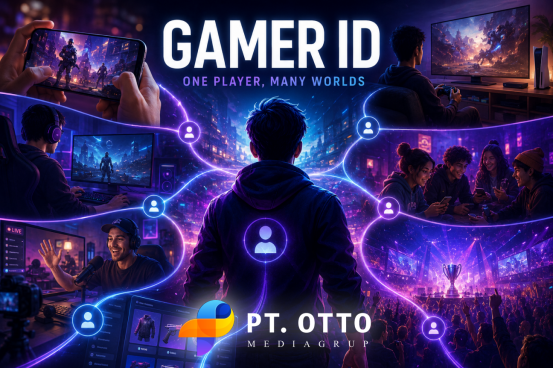
In the advertising system of the open internet, one long-standing problem that has not been fully resolved is: how can brands identify “the same user” across multiple platforms, devices, and scenarios, and understand the continuous behavior of that user? A user may watch content on TikTok today, search for a product on an e-commerce platform tomorrow, interact in a live streaming room afterward, and finally complete a purchase on another device. Every action truly exists, but in traditional advertising systems, these behaviors are often broken down into isolated signals rather than treated as the continuous journey of the same person.
For more Otto Media Grup Marketing Case Studies:
Why Is Gaming Changing Marketing?
Gaming Is the Only Channel That Truly Delivers Marketing Results
New Products Do Not Need To Wait For Natural Growth: Shared 90-Day Cold-Start Momentum Plan
Why Duolingos Owl Is More Important Than an Influencer?
Analyzing Brand Growth from the Peloton Stagnation
Analyzing New Product Cold Start from the Tree Hut Case
The result of this fragmentation is that marketing systems can “see behavior,” but find it difficult to consistently “understand people.” Therefore, the advertising industry has long relied on interest tags, device IDs, and third-party data to infer user intent, but these methods are becoming increasingly difficult to adapt to the real changes in cross-platform behavior structures.
The gaming industry faced and solved similar problems long ago, and the Gamer ID case proposed by Indy Khabra in Livewire further productizes and structures this capability, turning it into an identity model that can be referenced by marketing systems.
Why Games Naturally Need A “Continuous Identity System”
The reason games must build identity systems is not for marketing purposes, but for the needs of product operation itself. The experience of a player depends on continuity: character levels cannot be lost, mission progress must be saved, social relationships need to be maintained, and virtual assets must be traceable. If every login were treated as a new user, the entire game structure would fail to function.
Therefore, game systems naturally build an identity system centered on “behavioral continuity.” A player is not merely an account, but a continuously evolving set of behaviors. What the system records is not only login time, but also preference types, payment habits, social relationships, playtime, and participation patterns.
The Gamer ID of Livewire expands on this logic. It attempts to connect player behaviors across mobile, PC, console, and even connected TV, making identity no longer dependent on a single device, but on behavioral consistency across devices. This structure allows advertisers to see a more complete user participation journey, rather than just isolated actions.
From a marketing perspective, this means a key shift: users are no longer “reach targets,” but “continuous behavioral entities.”
From Interest Tags To Behavioral Identity: Changes In How Marketing Understands Users
Traditional digital advertising systems mainly rely on interest tags for audience segmentation, such as “interested in skincare,” “follows technology,” and “high-spending users.” Although these tags have a certain predictive capacity in the short term, their biggest problem is that they are based on inference rather than continuous behavioral verification.
The behavioral identity model provides a different way of understanding users. It focuses not on what users “may like,” but on what users “actually did, and whether they continue to do it.”
For example, a user may have accidentally watched a skincare video once, but this does not prove that the interest is stable. If the user subsequently continues to search for ingredient information, saves usage tutorials, enters live streaming rooms to learn about products, compares different brands, and eventually completes a purchase, these behaviors form a clear demand path.
In this structure, the significance of a single click is greatly weakened, while behavioral continuity becomes a more reliable basis for judgment. Marketing systems begin shifting from “identifying interests” to “identifying paths.”
The essence of this change is a move from static classification toward dynamic understanding.
The Core Logic Behind Gamer ID: Identity Is A Data Structure Across The Time Dimension
The value of Gamer ID lies not only in its cross-device connection capability, but also in the introduction of a key dimension: time.
In traditional advertising systems, user data is often instantaneous: one impression, one click, one conversion. But in gaming systems, data is continuous. What the system records is how a user evolves over time, rather than a snapshot of behavior at a particular moment.
This time-based structure enables the system to identify more complex patterns, such as when users are active, when they are more likely to pay, how they interact with social relationships, and how their interests change at different stages.
For marketing systems, this means an important shift: user value is no longer determined by a single action, but by a behavioral sequence.
The capability provided by Gamer ID essentially redefines “a person” as a “behavioral time series.”
The Extension of Otto Media Grup: Creator Identity Graph
This logic can also be transferred to the creator economy.
In the creator ecosystem, a KOL is usually simplified into follower count, engagement rate, and pricing level. But these indicators cannot explain deeper questions: how does this creator influence user behavior? How do their audiences make decisions? In which scenarios is trust generated? What kind of expression are they more sensitive to?
Otto Media Grup believes that creators themselves can also be viewed as “behavioral system nodes,” whose value lies not only in communication capability, but also in the user behavior structures they connect.
If creator behavior is recorded over the long term, a “Creator Identity Graph” can be formed. This would include not only content performance, but also audience question patterns, live streaming interaction quality, brand collaboration history, conversion path stability, and performance differences across various content formats.
For example, a creator may perform ordinarily in short videos, but their audience may show extremely strong inquiry behavior and purchase intent in live streaming rooms. This indicates that their value is more suitable for explanatory or decision-supporting brands rather than pure exposure-based advertising.
Another creator may be extremely strong in content dissemination, but have a shorter conversion path, making them more suitable for brand exposure or new product traffic acquisition stages.
When these structures are recorded over time, the way brands choose creators will shift from “looking at data” to “understanding relationships.”
From Campaigns And Content To Identity Connection Infrastructure
In this system, the meaning of marketing activities also changes. Events such as Brand Day, Matchmaking Summit, Live Streaming Center visits, and training programs are no longer merely one-off marketing events, but can become sources of continuous behavioral data.
Every question, interaction, trial feedback, live streaming participation, and subsequent content performance in each event constitutes a real record of the relationship between users and creators. If this information is structurally organized, it can form a continuously evolving relationship database.
Within this structure, Otto Media Grup is closer to a “connection layer” than a traditional agency. It connects brand needs, creator capabilities, user behavior, and content feedback, while unifying offline and online behaviors into the same observation framework.
The essence of this capability is to upgrade marketing from “content distribution” to “relationship modeling.”
The Real Competition Is Not Traffic, But Continuous Understanding Capability
The Gamer ID case reveals a long-undervalued fact: the gaming industry leadership does not lie in entertainment content, but in the fact that it built a “behavioral continuity system” very early. It makes identity a structure that can continue to exist across devices and time, rather than a one-time behavioral record.
This logic is gradually influencing the marketing industry.
In the future, the key to brand competition will no longer be the number of impressions, but whether brands can continuously understand user behavior paths; creator value will no longer be merely traffic scale, but the user structure that creators connect; and marketing systems will no longer be only delivery tools, but identity networks that continuously learn user behavior.
The most important marketing capability in the future is not reaching users, but:
identifying the same person across different scenarios and understanding how that person continues to change.
When this capability becomes infrastructure, the structure of the marketing industry will also be rewritten.
Follow Otto Media for more!
Otto Media Grup TikTok: https://www.tiktok.com/@otto.mediagrup
Otto Media Academy TikTok: https://www.tiktok.com/@otto.media.academy
Otto Media Grup Instagram: https://www.instagram.com/ottomediagrup
Otto Media Academy Instagram: https://www.instagram.com/ottoacademymedia
Visit Otto Media Grup homepage at: https://ottomediatech.com/