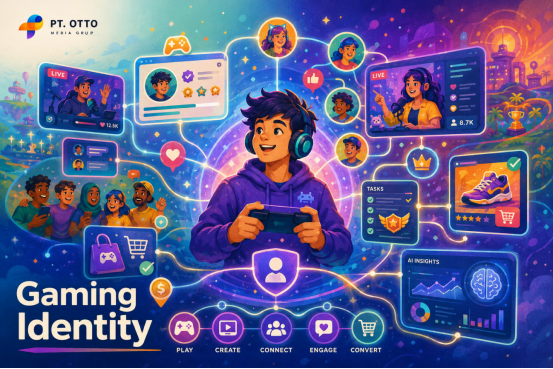
Over the past few years, when many brands have talked about game marketing, their first reaction has still been traffic, young users, esports sponsorships, or virtual advertising placements. However, Otto Media Grup believes that the deeper inspiration of gaming for the marketing industry is not merely that it has a large user base, but that it solved very early on a problem that the open internet is now facing again: when users are scattered across different platforms, different devices, and different content scenarios, how can brands truly understand who this person is, what they like, what they are participating in, and what they may be interested in next.
For more Otto Media Grup Marketing Case Studies:
Gaming Is the Only Channel That Truly Delivers Marketing Results
New Products Do Not Need To Wait For Natural Growth: Shared 90-Day Cold-Start Momentum Plan
Why Duolingos Owl Is More Important Than an Influencer?
Analyzing Brand Growth from the Peloton Stagnation
Analyzing New Product Cold Start from the Tree Hut Case
In traditional digital advertising, brands often rely on third-party cookies, platform tags, or broad interest categories to judge users. But these methods are becoming increasingly unstable. Users watch short videos on TikTok, ask questions in livestream rooms, join communities in games, place orders on e-commerce platforms, and scan codes to follow accounts at event venues. Every action is a real signal, but these signals are often scattered across different places. For brands, the difficulty does not lie in the absence of data, but in the fact that this data has not been organized into a clear user story.
The gaming world formed another logic very early on. A player has an account, a character, levels, mission records, interaction habits, purchase behavior, and relationships with friends, teams, and communities. Platforms do not need to rely only on guessing interests to understand users, because user behaviors themselves have continuously left clues. This structure gives Otto Media Grup an important insight: future marketing must learn to move from “seeing users” to “understanding continuous user behavior.”
I. The Core Value Of The Gaming World Is Making User Identity Continuous
In ordinary internet advertising, users are often fragmented. Today they see an advertisement, tomorrow they swipe to a short video, and the day after tomorrow they enter a livestream room. It is difficult for brands to determine whether these behaviors are related, and it is also difficult to know whether the user is truly interested or just passing by.
Gaming is different. Player behavior is usually continuous. What type of games a person plays, when they go online, whether they prefer solo challenges or team collaboration, whether they are willing to collect skins or improve skills—these behaviors gradually form a more complete identity. It is not a simple demographic label, such as age, gender, or city, but an interest structure composed of long-term behavior.
Otto Media Grup believes that the creator ecosystem can also draw on this logic. A fan following a beauty livestreamer does not only mean that they like beauty products; if they repeatedly watch fragrance content, ask about scent longevity in livestream rooms, save product pairing videos, and participate in offline events, then the interest displayed by this person is already very clear. If a brand only looks at one click, it can easily misjudge; if it looks at continuous behavior, it can more accurately understand user needs.
II. The Bridge Role of Otto Media Can Help Brands Organize These Real Signals
The advantage of Otto Media Grup lies in the fact that it simultaneously connects brands, creators, livestream scenarios, offline events, and content training. This position is unique because it can see content interactions that brands cannot see, and it can also see commercial needs that creators alone cannot see.
Taking the Matchmaking Summit 2026 jointly organized by Otto Media and Sadewi Essential Care as an example, the event included brand fragrance displays, exchanges among creators, KOLs, and supply chain partners, as well as a visit to a livestream center. Such a scenario itself is a process of collecting real signals. The questions raised by guests on-site, their reactions to fragrance products, their interest in livestream processes, and the directions of their communication with the brand side all have more reference value than simple online exposure.
This is the new capability that Otto Media can develop: turning scattered interactions into understandable cooperation leads. For example, certain types of KOLs may be more suitable for fragrance trial content, certain types of livestreamers may be better at explaining product stories, certain types of supply chain partners may be more suitable for short-video product seeding, and certain types of audiences may be more likely to ask questions in livestream rooms rather than purchase directly. Once these observations are organized, they will form marketing judgments that are more useful than ordinary advertising data.
If you are a micro-influencer, check out Can Micro-Influencers Really Build Brands? Otto Media Grup Evaluates Creator Marketing
III. Creators Are Not Only Communication Channels, But Can Also Become Entry Points For Identity Understanding
When using KOLs, many brands are still accustomed to first looking at follower count, interaction rate, and quotation. These indicators are useful, but they are not complete enough. The truly important question is: why are the users attracted by this creator willing to trust them? Do they care about price, function, lifestyle, or cultural taste? What questions will they ask in the comment section? What kind of expression will generate purchase interest in them?
Otto Media Grup believes that one of the greatest values of creators is helping brands understand user language. When brands introduce products themselves, they often use standard selling points; when creators express products, they naturally translate them into life scenarios that users can understand. For example, for a bottle of perfume, the brand may introduce the top notes, middle notes, and base notes, but a creator may say it is suitable for dating, work, dinners, Ramadan gatherings, or gifting. This kind of expression is closer to real consumer contexts.
The identity system in the gaming world gives creator marketing an inspiration: do not view users only as traffic, but view them as people with interest paths. A user moving from watching a short video, to saving content, to entering a livestream room, to trying fragrances offline, and then to purchasing products is a complete path. Otto Media can help brands see this path clearly and determine at which stage content is needed, at which stage livestreaming is needed, at which stage events are needed, and at which stage discounts or private-domain communication are needed.
IV. Future Marketing Systems Need To Connect Content, Livestreaming, Events, And AI
If gaming provides the logic of continuous identity, then Otto Media can apply this logic to the creator economy. For brands, the future should not be about only doing one event, one short video, or one livestream, but about designing a continuous interaction system.
The first step is content seeding, allowing users to understand the brand story. The second step is livestream explanation, allowing users to see how the product is used. The third step is offline experience, allowing users to develop real feelings. The fourth step is AI analysis, organizing comments, questions, livestream feedback, and event exchanges into the next round of content direction. In this way, marketing is no longer merely pushing information outward, but continuously learning from users.
This system is especially valuable for the Indonesian market. Indonesian users are highly active on social media, livestreaming platforms, and in the mobile internet environment. If brands want to grow, they cannot rely only on a single exposure. A more effective approach is to build trust through creators, explain products through livestreaming, create connections through events, and then use data and AI to find a better next step.
Otto Media Grup can play the role of a “connection layer” within this process. It connects brands and creators, and also connects online content with offline experiences; it connects supply chains with market feedback, and also connects AI tools with real marketing scenarios. Such a role is closer to the infrastructure required by future marketing than an ordinary agency company.
For more details in future marketing, check out How Do Different Ages Understand AI? Otto Media Grup Studies Generational Differences in Marketing
The Inspiration Gaming Gives To The Marketing Industry Is How To Understand Real People
Gaming is worth studying for brands not because it is young, lively, or has large traffic, but because it organized user behavior into continuous identity very early on. A player is not one click, and an audience member is not one view. Truly valuable marketing should understand continuous user reactions across different scenarios.
For Otto Media Grup, this is precisely the opportunity for the creator economy to enter its next stage. What brands need is not just more KOLs, but a clearer understanding of which creators are suitable for which products, which content can build trust, which interactions represent real interest, and which users are worth continuing to communicate with.
Future marketing competition will increasingly depend on this connection capability. Whoever can connect content, creators, livestreaming, events, supply chains, and AI analysis will find it easier to understand the market and help brands find growth paths that truly suit them.
FAQ
Q1: Why Is Gaming So Important To The Marketing Industry?
Because gaming was among the earliest to solve the “user identity continuity problem,” rather than relying on single behaviors.
Q2: What Is Identity Infrastructure?
It refers to a system that can continuously record and understand user behavior paths, rather than single-point labels.
Q3: What Is The Role Of Creators In Marketing?
Creators are “language translators,” transforming brand information into user life contexts.
Q4: Why Are Clicks No Longer Important?
Because clicks are momentary behaviors, while marketing is shifting toward long-term behavior path analysis.
Q5: What Is The Core Competition In Future Marketing?
It is not exposure capability, but identity understanding capability and behavior path modeling capability.
Follow Otto Media for more!
Otto Media Grup TikTok: https://www.tiktok.com/@otto.mediagrup
Otto Media Academy TikTok: https://www.tiktok.com/@otto.media.academy
Otto Media Grup Instagram: https://www.instagram.com/ottomediagrup
Otto Media Academy Instagram: https://www.instagram.com/ottoacademymedia
Visit Otto Media Grup homepage at: https://ottomediatech.com/
One Response