How Do Different Ages Understand AI? Otto Media Grup Studies Generational Differences in Marketing
If you look only at usage data, AI has already shifted from a “new technology” to a “basic tool.” According to the industry data from Otto Media, a large number of consumers have already encountered generative AI in daily life—whether in search, recommendations, or content creation—AI is becoming the default entry point.
But what is truly worth attention is not the “scale of use,” but the “maturity of perception.” Data shows that about 43% of users started using generative AI within the past six months, and some only tried it for the first time in the past month. This means most users are still in the exploration stage, not yet in the stable usage phase.
Otto Media believes this phenomenon of “usage preceding understanding” will become a key variable in future marketing. User behavior has already changed, but their perception is not yet settled, putting the entire market in a transitional state. Brands are facing not a mature AI user base, but a group of consumers constantly adjusting their cognitive frameworks.
Generational Differences Define the “Different Roles” of AI
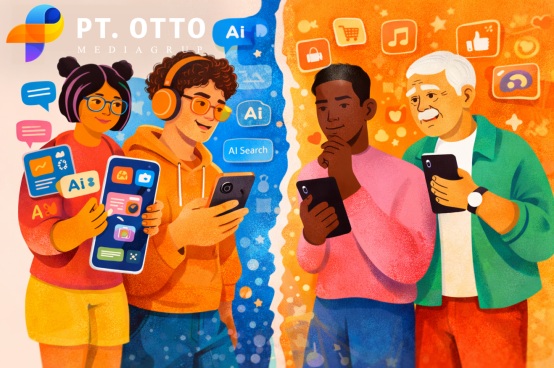
Looking deeper, the biggest divergence of AI is not in frequency of use, but in usage patterns. Different age groups show clear differences in their understanding and engagement with AI.
Data shows younger users accept AI much more readily. About 62% of Gen Z and 68% of Millennials prefer products with AI features, while this proportion drops significantly among older populations. This difference is not only attitudinal but behavioral.
Otto Media points out that young users actively explore AI tools, viewing them as core means to improve efficiency and access information; older users more often use AI unknowingly, such as via recommendation systems or automated services. This means:
AI is not the same “product form” for everyone.
For younger people, it is a tool.
For older users, it is an environment.
This difference directly determines that brand communication strategies can no longer be “one-size-fits-all,” but must be layered according to user perception.
Trust, Not Usage, Becomes the New Decision Threshold
Compared to “whether to use AI,” a deeper divide is:
Whether users trust the output from AI.
Research shows clear generational differences in trusting AI. Younger users are more likely to accept AI recommendations, while older users tend to double-check. This is especially critical in consumption decisions.
Otto Media believes this structure brings a new marketing reality:
AI is already involved in decisions, but trust has not been established in parallel.
In traditional advertising, brands compete for attention; in the AI ecosystem, they compete for “acceptance probability.” Especially in conversational recommendations and AI search, users often do not distinguish between ads and suggestions—if trust is lacking, recommendations lose meaning.
Thus, trust is no longer an added value for brands, but the prerequisite for the entire conversion path.
Marketing Is Entering the “Layered Trust Strategy” Phase
From the perspective of Otto Media, the real change brought by AI is not technical upgrades, but the fragmentation of user structure. Differences in usage, understanding, and trust levels among groups make unified communication strategies increasingly ineffective.
The future marketing system will rely more on “layered trust strategies.” Brands must design different information expressions for groups with different cognitive states. For younger users, emphasize efficiency and innovation; for older users, focus on reliability and practical value.
More importantly, brands need to learn to “translate AI.” As research points out, users do not care about the technology itself, but whether it solves real problems. Otto Media sees this as a key shift:
AI is no longer just a technical variable, but a user cognitive variable.
From the perspective of Otto Media, AI has not unified user behavior; it has amplified differences. Generational cognitive gaps are shifting the market from “traffic competition” to “trust competition.”
As AI becomes the information entry point and users increasingly rely on system recommendations, brands need to fight not for exposure, but for trust weighting among different groups.
The future of marketing is not about reaching more people, but about making the right people believe.
Follow Otto Media for more!
Otto Media Grup TikTok: https://www.tiktok.com/@otto.mediagrup
Otto Media Academy TikTok: https://www.tiktok.com/@otto.media.academy
Otto Media Grup Instagram: https://www.instagram.com/ottomediagrup
Otto Media Academy Instagram: https://www.instagram.com/ottoacademymedia
Visit Otto Media Grup homepage at: https://ottomediatech.com/