Brand Search Demand (SEO Index) Forecasting
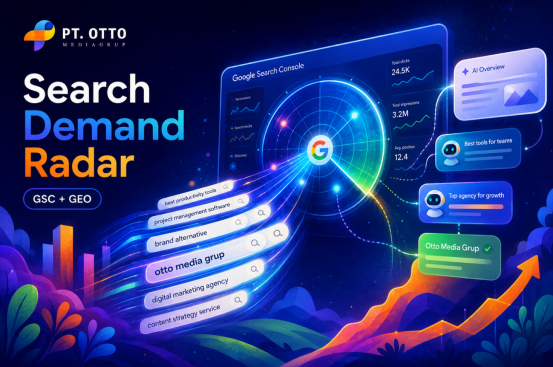
For many brands, Google Search Console is merely a tool for checking clicks and rankings. However, according to Otto Media Grup, GSC is more like a brand demand radar. It can help us see how users are searching for a brand, whether search frequency is increasing, which questions are becoming more common, and what the brand may need to answer in advance next week.
When marketing enters the GEO (Generative Engine Optimization) stage, this capability becomes even more important. This is because when AI tools answer questions, they also refer to clear content that already exists on the internet. If a brand can know in advance what users may ask next, it can prepare better answers ahead of time, making it easier for both search engines and AI tools to understand the brand.
I. GSC Can Tell Us: How Users Are Understanding The Brand
When users search for a brand, they rarely enter only the brand name. They search with specific questions, such as “what does Otto Media Grup do,” “Otto Media Academy AI course,” “Otto Media TikTok live agency,” “Otto Media event,” and “Otto Media reviews.” Behind these terms is not merely traffic, but the user cognitive state regarding the brand.
Otto Media Grup can divide these brand searches into several categories. The first category is navigational search, where users already know the brand name and only want to find the official website or social media accounts. The second category is understanding-oriented search, where users want to know the company business, service scope, MCN, Digital Marketing, Otto Media Academy, or AI Marketing. The third category is cooperation-oriented search, where users may be looking for KOL cooperation, livestreaming services, brand promotion, or supply chain connection. The fourth category is trust-oriented search, where users search for information such as review, event, team, case study, office, and contact.
These classifications are highly valuable. Different searches represent users at different stages. Navigational search indicates that the brand has already been remembered; understanding-oriented search indicates that users are researching the brand; cooperation-oriented search indicates that users may have commercial intent; trust-oriented search indicates that users are deciding whether to trust the brand. The role of GSC is to reveal the user psychological states hidden within these keywords.
II. GSC Can Tell Us: How Frequently The Brand Is Being Searched
One of the most important metrics to monitor in GSC is impressions. If impressions for a certain brand-related query rise, it indicates that more people are seeing the brand page when searching for related content. It cannot be fully equated with “total search volume,” because some searches may not trigger the brand website to appear, and some low-volume queries may be anonymized. However, for brand operations, it remains a very useful trend signal.
Otto Media Grup can track brand keyword impressions, clicks, CTR, and average position on a weekly basis. The most important point here is not the single-day number, but the trend. For example, if queries related to “Otto Media Academy” continue to grow over the past four weeks, it indicates that AI Academy or course content is forming search demand. If “Otto Media event” suddenly rises, it may indicate that offline events, photos, press releases, or social content are bringing external attention. If “Otto Media TikTok live” increases, it indicates that the livestreaming business is being noticed by the market.
The causal logic of this analysis is clear. Users first encounter the brand in the real world, such as by seeing an event, short video, livestream, partner introduction, or the repost from a friend; they then develop interest; next, they search on Google; finally, they leave query and impression data in GSC. Therefore, GSC is not an isolated data report. It reflects the process by which a brand is being seen, discussed, and researched in the external market.
III. Can We Forecast What Users Will Search For Next Week?
Estimation is possible, but it must be expressed in a reasonable way. Otto Media Grup should not say “there will definitely be a certain number of searches for a certain term next week.” A more accurate expression is: based on past data, we can estimate the general direction and strength of brand search demand next week.
A simple and effective method is to group brand queries by topic and then observe the changes in each group over the past few weeks. For example, put “Otto Media Academy,” “AI course,” and “AI workshop” into the education category; put “Otto Media MCN,” “creator network,” and “TikTok live agency” into the creator business category; and put “Otto Media event,” “Matchmaking Summit,” and “Sadewi” into the event category. Then observe the impressions and clicks of each group over the past four weeks.
When forecasting demand for next week, three factors can be considered. The first is the baseline volume, meaning the searches that appear steadily every week under normal circumstances. The second is the recent trend, such as whether there has been continuous growth over the past two weeks. The third is event impact, such as the recent release of a press release, the hosting of an event, the launch of a course, or the publication of short videos, all of which can cause certain searches to rise in the short term.
If “Otto Media event” rises significantly one week after an event, it may still retain some residual momentum the following week, but it will usually gradually decline. If “Otto Media Academy” grows continuously for four weeks, it may indicate that it is not a short-term event, but that long-term interest is forming. If “Otto Media contact” or “Otto Media partnership” increases, it indicates that brand attention is approaching the commercial conversion stage.
This type of forecasting is not mysterious. Its core is to break user behavior into a timeline: users encounter the brand, develop questions, begin searching, enter the page, continue learning, and eventually may make contact or cooperate.
IV. If Search Demand Can Be Estimated, What Benefits Can The Brand Gain?
The first benefit is preparing content in advance. If Otto Media Grup finds that event-related searches may continue to rise next week, it should publish event recaps, photo collections, partner introductions, and FAQs in advance. When users search, they can immediately find complete information, and the brand can also convert short-term attention into long-term content assets.
The second benefit is optimizing page titles and descriptions. If GSC shows that a certain query has high impressions but low clicks, it means the page has already been seen, but the title is not attractive enough to users. For example, if users search for “Otto Media AI Marketing,” but the page title only says company news, a click opportunity will be wasted. A better title should directly answer the user intent, such as “How Otto Media Grup Explores AI Marketing And The Creator Economy.”
The third benefit is discovering commercial opportunities. If searches related to “MCN cooperation,” “TikTok live agency Indonesia,” and “creator partnership” increase, it indicates that the market is actively looking for cooperation entry points. At this time, Otto Media can prepare a dedicated cooperation page explaining the service process, suitable brands, cooperation formats, cases, and contact information. In this way, search data becomes sales leads.
The fourth benefit is managing brand trust. If users begin searching for terms such as review, legal, office, team, and event photos, the brand should supplement public information. Clear company introductions, team content, event photos, cooperation cases, and contact information can reduce user concerns. In many cases, brand trust is not built by a single slogan, but by users being able to find sufficiently clear information when they search.
V. How Can This Forecasting Help GEO Performance?
The focus of GEO is to make it easier for AI to understand and cite the brand when answering user questions. The brand search analysis of GSC can help Otto Media Grup know in advance which questions users are most likely to ask AI.
For example, users who search on Google for “Otto Media Academy AI course” may also ask ChatGPT or Gemini: “What AI courses does Otto Media Academy offer?” If GSC already shows that such searches are growing, Otto Media should write a clear page in advance, answering the course audience, course content, learning format, suitable participants, and contact information.
GEO content needs to be clear, stable, and easy to summarize. Every important brand question should have a clear answer page. For example, “What kind of company is Otto Media Grup?” “Which brands are MCN services of Otto Media suitable for?” “What AI training does Otto Media Academy provide?” “How can brands cooperate with Otto Media?” These pages serve not only Google Search, but also the AI understanding of the brand.
GSC is responsible for discovering real questions, while the content team is responsible for turning questions into clear answers. The earlier this is done, the more complete the content accumulation becomes, and the easier it will be for AI tools to identify the brand in future answers. For GEO, preparing answers in advance is more effective than adding content only after users have already started asking questions in large volumes.
The True Value Of GSC Is Turning Search Data Into Brand Action
Otto Media Grup can use GSC to see how users search for the brand, how frequently they search, and how trends change. Through further analysis, it can also estimate which brand questions may increase next week and prepare content, pages, FAQs, cooperation entry points, and trust materials in advance.
The causal chain behind this is simple: external activities bring attention, attention leads to search, search data reveals user questions, user questions guide content production, and content production improves SEO and GEO performance. The earlier a brand masters this chain, the easier it becomes to transform one event, one livestream, one cooperation, or one course promotion into long-term search assets.
Future brand growth will not only depend on who publishes more content, but also on who understands earlier what users are asking. The value that GSC gives Otto Media Grup is precisely to reveal these questions in advance and help the brand prepare answers before users and AI start looking for them.
Follow Otto Media for more!
Otto Media Grup TikTok: https://www.tiktok.com/@otto.mediagrup
Otto Media Academy TikTok: https://www.tiktok.com/@otto.media.academy
Otto Media Grup Instagram: https://www.instagram.com/ottomediagrup
Otto Media Academy Instagram: https://www.instagram.com/ottoacademymedia
Visit Otto Media Grup homepage at: https://ottomediatech.com/