Otto Media Grup Digital Marketing Hack
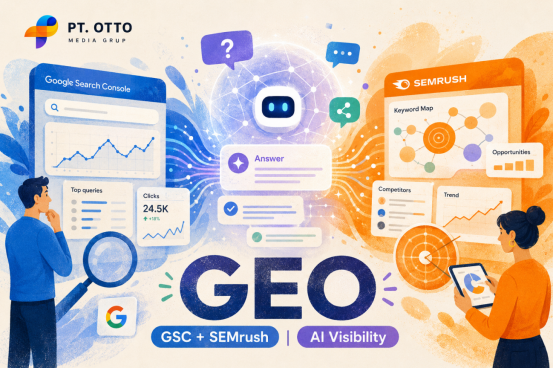
When users begin to ask questions to AI tools such as ChatGPT, Gemini, and Perplexity, many brands naturally start to pay attention to GEO (Generative Engine Optimization). In simple terms, GEO focuses on the following: when an AI answers a specific question, whether a brand, article, product, or viewpoint has the opportunity to be understood, cited, and recommended by the AI.
This sounds like a completely new field, but Otto Media Grup believes that the foundation of GEO still relies on two classic tools: Google Search Console and SEMrush. The reason is simple: before AI answers questions, it still needs to understand what humans are concerned about; for a brand to enter the answers of AI, it also needs to first know what users are truly asking and what answers the market still lacks. GSC and SEMrush happen to provide these two types of clues.
1. GSC GEO Value: See How Users Are Already Asking Questions
The most valuable aspect of Google Search Console is that it records the actual query terms users employ when they find a website through Google. For GEO, these query terms are very important because they are increasingly approaching natural language questions.
In the past, SEO teams may have focused only on short keywords, such as “AI marketing,” “TikTok agency,” and “MCN Indonesia.” However, in the GEO era, Otto Media Grup recommends paying more attention to search terms that resemble questions, for example, “How can small and medium-sized enterprises start AI marketing,” “How to conduct live-streaming sales on TikTok,” and “Why do brands need MCN.” These query terms can be directly transformed into article titles, FAQs, case study pages, and tool guides.
GSC can also help teams determine which content already has “answer potential.” If a page appears in multiple related queries and maintains a stable click-through rate, it indicates that users already consider the page to have reference value. Such pages are well-suited for further upgrading into GEO content assets, such as adding clear definitions, step-by-step instructions, case explanations, comparison tables, and frequently asked questions, making it easier for AI to understand the structure of the article.
2. SEMrush GEO Value: Identifying Unanswered Market Questions
SEMrush is more suitable for observing the market from an external perspective. It can help Otto Media Grup see keyword search volume, competition intensity, competitor rankings, related topics, and content gaps. For GEO, the greatest value of SEMrush lies not only in keywords but also in helping brands build a complete problem map.
For example, if a brand wants to focus on the topic of “AI marketing tools,” SEMrush can help the team continue to identify related directions: AI content creation, AI ads automation, AI analytics, AI customer service, and AI marketing workflow. By linking these topics together, the website will no longer have just a single article but will form a complete knowledge area.
When generating responses, AI systems tend to favor websites that offer complete information, clear structure, and long-term coverage of a specific topic. Otto Media Grup therefore recommends that brands focus less on chasing isolated trending keywords and more on building topic clusters. A topic cluster may include basic explanations, tool recommendations, industry case studies, operational steps, risk reminders, and FAQs. Such a content system is closer to the “comprehensible knowledge base” that AI requires.
3. Combining GSC and SEMrush: From a Keyword List to a GEO Question Map
GSC and SEMrush are best used together. GSC tells us how users are already finding you, while SEMrush tells us what related demands in the market are worth covering. When combined, the SEO table can be upgraded into a GEO problem map.
Otto Media Grup recommends that the team conduct a simple review once a month. First, export queries with high impressions and low clicks from GSC to identify which titles require optimization. Then, look for pages ranked between positions 8 and 20 to determine which content is close to achieving a better ranking. Next, use SEMrush to examine competitor articles on the same topic and check whether they have supplemented cases, tools, pricing, steps, or FAQs.
The focus of this process is to identify “answer gaps.” For example, a user has searched for “AI marketing tool recommendations,” but your article only lists tools without explaining which scenarios they are suitable for; a user searches for “How MCN helps TikTok creators,” but the page only provides a company introduction without detailing the collaboration process. Once such gaps are filled, the content becomes more friendly to both search engines and AI systems.
4. GEO Content Should Be Written Like an Answer, Not Like an Advertisement
A highly practical principle for content writing in the GEO era is that an article should resemble a serious answer to a question, rather than a brand promotional page. When summarizing content, AI tools can more easily identify articles that have clear definitions, complete logic, explicit evidence, and stable structure.
Otto Media Grup can adopt a fixed structure in content production: first explain why users care about this issue, then provide the core conclusion, followed by methods, cases, applicable scenarios, and common misconceptions. Such a structure is reader-friendly and also facilitates AI in extracting information.
GSC can help us identify the questions users are asking, and SEMrush can help us determine which of these questions have market value. The real skill lies in writing this content in a way that is clear, credible, and easy to cite. For example, a title could be changed from “Otto Media AI Marketing Services” to “How Can Small and Medium-Sized Brands Use AI for Content Creation, Advertising, and Customer Interaction?” The former reads like a company introduction, while the latter resembles a question a user would ask and is more suitable for being cited in AI response scenarios.
5. True Marketing Skills: Turning a Website into a Knowledge System That AI Can Understand
When many brands implement GEO (Generative Engine Optimization), they rush to study what AI prefers. Otto Media Grup instead recommends first organizing website content into a clear knowledge system. AI needs to understand who the brand is, what it excels at, what problems it solves, which audiences it serves, and what cases and evidence it has.
This requires that the content of the website be interconnected. For example, one article discusses AI marketing tools, another covers AI content production, and a third addresses AI advertising optimization. Finally, an overview page connects them all. Internal links, clear headings, FAQs, case explanations, and consistent use of terminology will help search engines and AI systems establish a clearer understanding.
The long-term value of GEO comes from accumulation. A long-tail question appearing in GSC today may become a key query in an AI response tomorrow. A content gap discovered in SEMrush today may become the most worthwhile new topic next month. The earlier a brand begins organizing these questions, the easier it is to secure a position in AI search and generative answers.
The Core of GEO Is Turning User Questions into Brand Answers
From the perspective of Otto Media Grup, Google Search Console and SEMrush remain highly important in the GEO era. GSC provides real user queries, while SEMrush offers market opportunities and competitive gaps. When the two are combined, brands can more clearly determine what to write, what to update, what to supplement, and how to make content easier for both users and AI to understand.
In the future, content competition will place increasing emphasis on “answer quality.” Brands that can consistently address real questions will be more easily discovered by search engines and will also be more likely to be included in AI recommendations and summaries.
For Otto Media Grup, GEO is not a mystery. Its starting point remains understanding the user, and its endpoint is the establishment of a clear, credible, and continuously updated brand knowledge system.
Follow Otto Media for more!
Otto Media Grup TikTok: https://www.tiktok.com/@otto.mediagrup
Otto Media Academy TikTok: https://www.tiktok.com/@otto.media.academy
Otto Media Grup Instagram: https://www.instagram.com/ottomediagrup
Otto Media Academy Instagram: https://www.instagram.com/ottoacademymedia
Visit Otto Media Grup homepage at: https://ottomediatech.com/