Otto Media Grup Digital Marketing Hack
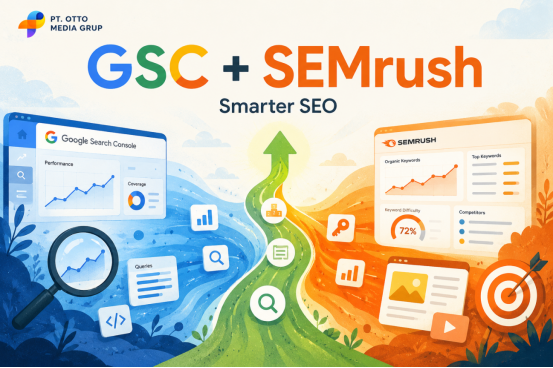
Otto Media Grup would like to discuss a very practical but often misunderstood issue: why do the data from Google Search Console and SEMrush frequently differ? More importantly, how should brands actually combine these two sets of data instead of wasting time on numerical discrepancies?
Many teams mistakenly treat Google Search Console and SEMrush as interchangeable SEO tools. This is the first misconception. In reality, they observe entirely different worlds. Google Search Console shows the actual performance of your own website in Google Search, including clicks, impressions, CTR, and average ranking. Google officially states that the Performance report in Search Console is used to explain metrics such as impressions, position, and clicks. SEMrush, on the other hand, functions more like a market radar. Through its own database, algorithms, and third-party data, it helps you observe keyword volume, competitors, search intent, keyword difficulty, traffic estimates, and ranking changes.
Otto Media Grup believes that the correct approach is not to ask “whose data is more accurate,” but rather to ask “which tool answers which question.” GSC answers: How have users already found us? SEMrush answers: What opportunities in the market have we not yet captured?
1. GSC Is Real Performance, SEMrush Is Market Map
The greatest value of Google Search Console lies in the fact that its data comes from Googles own search performance metrics. It can tell you how many impressions a specific page has received, how many clicks it has obtained, what the CTR is, and what the average ranking is. For content teams, this data is extremely critical because it is not an estimate, but rather your actual search performance that has already occurred.
However, the limitations of GSC are also quite evident. It primarily tells you “the queries you have already encountered,” rather than providing a complete picture of “all potential keywords in the market.” In other words, GSC is more like a rearview mirror: it can show you the search scenarios you have already entered, but it may not necessarily reveal the opportunities you have yet to cover.
SEMrush takes the opposite approach. Its value lies in an external market perspective. According to the official documentation of Semrush, its Keyword Overview feature can provide data such as monthly search volume, search intent, ranking difficulty, and CPC for keywords. The Position Tracking feature can monitor the ranking of target keywords on a daily basis and supports dimensions such as device, region, and search engine.
Therefore, the first recommendation of Otto Media Grup is: do not use SEMrush to replace GSC, and do not use GSC to dismiss SEMrush. GSC focuses on actual performance, while SEMrush focuses on market opportunities.
2. Two Sets of Data Are Best Suited for Solving the “Keyword Priority” Problem Together
The most common problem faced by SEO teams is not a lack of keywords, but having too many keywords and not knowing which one to prioritize. In such cases, the combination of GSC and SEMrush proves to be highly valuable.
The first category of opportunity consists of keywords in GSC with high impressions but low CTR. This indicates that Google is willing to display your page, but users do not have a sufficiently strong desire to click. The issue here is usually not the absence of content, but rather that the title, meta description, or search intent matching is not strong enough. The approach is straightforward: rewrite the title, strengthen the entry point of the problem, and add stronger click signals such as year, comparison, steps, price, and case studies.
The second category of opportunities consists of keywords ranked between 8th and 20th in the GSC. These keywords are generally the most worthy of priority optimization, because the pages are already close to the first page or the lower half of the first page. By merely supplementing content depth, internal links, FAQs, structured headings, or updating information, significant improvement can be achieved.
The third type of opportunity consists of keywords that show high search volume and moderate competition intensity in SEMrush, but have no data at all in GSC. This indicates that market demand exists, but your website has not yet entered the user search path. Such keywords are suitable for creating new articles, new landing pages, or topic-specific pages.
Otto Media Grup recommends creating a simple matrix: use GSC to determine “our existing performance” and use SEMrush to determine “market potential.” Ultimately, keywords are divided into three groups: optimize immediately, maintain continuously, and create new content. In this way, SEO is no longer based on intuition for topic selection but on joint decision-making based on actual performance and external opportunities.
3. Use GSC To Find “Content Funnel Issues”, Use SEMrush To Find “Competitive Gaps”
If one only focuses on traffic, SEO can easily become superficial work. What truly matters in analysis is identifying at which step users drop off.
GSC can help us identify issues within the content funnel. If there are many impressions but few clicks, it indicates that the title and summary do not resonate with users. If clicks are good but rankings do not improve, it suggests that the content may meet some user needs but lacks depth, authority, or internal linking. If a specific page generates many long-tail queries, it indicates that the page may be suitable for expansion into a content cluster.
SEMrush is suitable for supplementing competitive gaps. For example, if a competitor has consistently ranked high for a specific set of keywords over a long period, while you have not entered the top 100, this is not simply a ranking issue but a lack of content assets. The Semrush Position Tracking tool can track the ranking changes of both yourself and your competitors for target keywords, and it supports local location and device dimensions.
Otto Media Grup believes that there is a very practical technique here: do not only compare individual keywords, but compare “topic coverage.” For example, if Otto Media wants to engage in AI marketing, it should not only look at the single term “AI marketing tools,” but should simultaneously examine the entire set of topics such as AI marketing strategy, AI marketing automation, AI content creation, AI analytics, and AI advertising. The party with more comprehensive coverage is more likely to be understood by search engines as a content authority in that field.
4. Merge the Two Sets of Data into a “Content Update System”
SEO is often not about writing new content, but about continuously updating old content. GSC is the most suitable tool for making content update decisions.
Otto Media Grup recommends exporting GSC data on a monthly basis and filtering out three types of pages: first, pages with increasing impressions but declining CTR, indicating rising demand but insufficient click appeal; second, pages with declining rankings but still receiving impressions, suggesting that the content may be outdated and requires updating; third, pages with growing clicks but weak conversions, indicating a good traffic source but inadequate page engagement.
Then use SEMrush to check the competitive changes of the keywords corresponding to these pages. If a competitor has published more comprehensive content, or if new formats such as videos, FAQs, AI Overviews, or shopping results have appeared in the SERP, the content structure needs to be adjusted, rather than merely changing a few words.
Google has provided Search Console bulk data export, which allows GSC data to be continuously exported to BigQuery. The official documentation states that this feature enables websites to persistently export Search Console data to BigQuery. For teams with large content volumes, this means SEO is no longer limited to manually reviewing reports; instead, it enables the creation of automated dashboards for continuously tracking changes in pages, keywords, clicks, impressions, and CTR.
5. Real Marketing Skills: Turning SEO Data Into Content Production Rules
The most valuable outcome of combining GSC and SEMrush is not the reports, but the content rules.
For example, if GSC shows that users frequently search for “how to”, “best tools”, “comparison”, and “2026 guide”, it indicates that users need method-oriented content rather than brand introductions. In this case, the article title of Otto Media should be more like “Five Major Application Scenarios and Tool Recommendations for AI Marketing” instead of “Otto Media Introduces AI Marketing”.
If SEMrush indicates that the search intent of a keyword is commercial rather than informational, the article must include tool recommendations, pricing dimensions, comparison tables, and purchase decision suggestions. Otherwise, even if the article achieves ranking, it may fail to drive conversions.
If GSC shows that a certain article has received a large number of unexpected long-tail keywords, this is usually an opportunity for content expansion. For example, an article about MCN may unexpectedly receive impressions for “TikTok live streaming agency Indonesia.” At this point, do not simply be happy looking at the data; instead, immediately create a corresponding landing page to turn accidental traffic into proactive planning.
The core judgment of Otto Media Grup is: GSC tells you how users already understand you, while SEMrush tells you what the market still expects you to answer. Only when the two are combined do they form a true content growth system.
Do Not Compare Numbers; Combine Perspectives
From the perspective of Otto Media Grup, the differences between GSC and SEMrush are not a problem but a source of value.
GSC represents actual results, while SEMrush represents external opportunities. GSC is suitable for diagnosis, and SEMrush is suitable for planning. GSC tells you which pages already have search signals, and SEMrush tells you which keywords and competitive spaces have not yet been occupied.
A truly mature SEO team in the future will not simply ask “what is the search volume of this keyword” nor will it only look at “how many clicks this article received.” Instead, they will integrate search performance, market demand, competitive gaps, and content update cadence into a continuous optimization system.
For Otto Media Grup, SEO is no longer merely a ranking task; it is a long-term approach to understanding user needs, designing content assets, and connecting brand growth.
Follow Otto Media for more!
Otto Media Grup TikTok: https://www.tiktok.com/@otto.mediagrup
Otto Media Academy TikTok: https://www.tiktok.com/@otto.media.academy
Otto Media Grup Instagram: https://www.instagram.com/ottomediagrup
Otto Media Academy Instagram: https://www.instagram.com/ottoacademymedia
Visit Otto Media Grup homepage at: https://ottomediatech.com/
2 Responses