From 100 Cases, Otto Media Grup Identifies A More Replicable Operating Template For AI Marketing In H1 2026
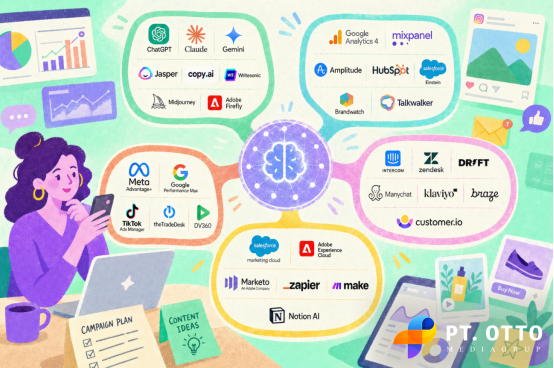
After systematically reviewing 100 public AI marketing cases and tool application samples between 2024 and the first quarter of 2026, the AI Marketing Development Team at Otto Media Grup identified a recurring trend: companies initially adopt AI to improve efficiency, but as implementation deepens, AI is gradually transforming marketing from a manually driven execution process into a system capable of continuous optimization.
These cases span multiple industries, including e-commerce, finance, SaaS, consumer brands, and content platforms. Whether AI is used to generate advertising creatives, optimize media buying, or support customer interaction and user analysis, most companies initially begin by simply trying to “do things faster with AI.” But as the applications deepen, marketing is gradually shifting from a manually driven execution process into a system that can operate continuously.
In other words, AI is not merely optimizing one specific link in the chain; it is changing how marketing itself is run.
Content Generation: AI Does Not Solve Creativity, But The Problem Of Expressive Scale
Among the 100 cases, content generation was almost always the first step companies took into AI marketing. From ad copy to short-video scripts, from social media operations to e-commerce product pages, AI has gradually become part of the infrastructure of content production.
But further observation shows that what truly creates differentiation is not whether AI is being used, but whether AI is being used to build scalable expressive capability. Leading brands are able to switch content quickly across different platforms, different audiences, and different contexts, thereby achieving more frequent and better-matched outreach.
At the tool level, ChatGPT, Claude, and Gemini are better suited for strategy and copy generation; Jasper, Copy.ai, and Writesonic are used for batch marketing content; while Midjourney, Adobe Firefly, and Canva Magic Studio have become important tools for visual asset production.
The core conclusion of Otto Media Grup is that AI has not solved the “creativity problem”; it has amplified expressive capability. The real bottleneck has shifted from production capacity to selection capability.
User Insight: AI Allows Data To “Participate In Decision-Making” For The First Time
The second significant change comes from the way user data is used. In traditional marketing, data was used more for retrospective analysis; in an AI-based system, data begins to participate directly in the decision-making process.
For example, some e-commerce platforms use AI to analyze user browsing paths and purchasing behavior, thereby predicting conversion probability in advance; SaaS companies, meanwhile, use behavioral modeling to optimize product onboarding and sales rhythm. What these applications have in common is that data no longer merely records the past; it now influences the future.
In this scenario, Google Analytics 4, GSC (Google Search Console) and SEMrush, Mixpanel, and Amplitude provide the foundation for behavioral analysis; HubSpot AI and Salesforce Einstein support customer segmentation and prediction; Brandwatch and Talkwalker are used to understand social context and sentiment.
Otto Media Grup assesses that marketing is beginning to develop the ability to “understand users,” rather than merely reach them.
Advertising Delivery: Moving From Experience-Driven Execution To An Automated Optimization System
In the field of advertising delivery, the impact of AI is even more direct. A large number of cases show that AI can complete multivariable testing in a very short period of time, while continuously optimizing budget allocation and audience selection.
More and more brands are handing part of their manual campaign tuning over to automated systems, allowing the system to move automatically toward optimal results. This is shifting media buying from “experience-based decision-making” toward “system-driven operation.”
In this scenario, mainstream tools suitable for programmatic buying and cross-channel ad management include Meta Advantage+, Google Performance Max, and TikTok Ads Manager; while The Trade Desk and DV360 are more suitable for more complex delivery structures.
The core judgment of Otto Media Grup is that the essence of AI-driven advertising is not greater precision, but greater continuity. Marketing is shifting from point optimization to continuous optimization.
Customer Interaction: AI Extends The “Duration Of Brand Presence”
One frequently overlooked yet highly valuable change is the transformation of how brands interact with customers. AI is enabling brands to move from “passive response” to “continuous presence.”
AI customer service can respond to user questions instantly, recommendation systems can provide personalized suggestions based on behavior, and automated marketing tools can trigger different content at different stages. This allows brands to move from “appearing once” to “remaining present continuously.”
In this scenario, Intercom, Zendesk, Drift, and ManyChat support real-time communication; Klaviyo, Braze, and Customer.io are used for lifecycle marketing.
Otto Media Grup tends to understand these tools as relationship extenders rather than merely labor substitutes.
Marketing Automation: The Real Divide Lies In Whether A System Has Been Built
At the real dividing line of AI marketing, what ultimately creates separation is not the use of any single tool, but whether a system has been built.
Companies that merely use AI tools usually gain only localized efficiency improvements; companies that integrate content, data, delivery, and customer relationships, by contrast, gradually build a marketing system capable of sustained operation.
At this level, HubSpot, Salesforce Marketing Cloud, Adobe Experience Cloud, and Marketo provide complete solutions; while Zapier, Make, and Notion AI help teams connect different tools to form lightweight workflow links and operational collaboration.
Otto Media Grup concludes that the core of AI marketing is not the number of tools used, but the ability to integrate systems.
The Common Answer Behind 100 Cases
According to the Otto Media Grup research on 100 AI marketing cases, these five major application scenarios are not independent of one another, but together form a new marketing structure.
Content generation solves expression, data analysis provides understanding, delivery optimization drives outcomes, customer interaction extends relationships, and automation systems connect everything together. This also means that future competition in marketing will no longer be about who uses more tools, but about who completes the transition earlier from being a “tool user” to becoming a “system builder.”
When that transformation occurs, marketing will no longer merely support growth; it will become growth itself.
Follow Otto Media for more!
Otto Media Grup TikTok: https://www.tiktok.com/@otto.mediagrup
Otto Media Academy TikTok: https://www.tiktok.com/@otto.media.academy
Otto Media Grup Instagram: https://www.instagram.com/ottomediagrup
Otto Media Academy Instagram: https://www.instagram.com/ottoacademymedia
Visit Otto Media Grup homepage at: https://ottomediatech.com/