Otto Media Grup Re-Examines the Endpoint of Traffic Dependency
For more Otto Media Grup Marketing Case Studies:
After Retail Media Matures, Does “Measurement Capability” Become a New Bottleneck for Brand Growth?
The Rise of “Evidence-Based Brands” from the Perspective of Texas A&M University
Where Does AI End and Creative Strategy Begin?
Over the past two decades, leaving Google Search was almost equivalent to voluntarily giving up website traffic. Publishers allowed search engines to crawl their content, and Google then sent users back to their websites, creating an exchange relationship of “content for clicks” between the two sides.
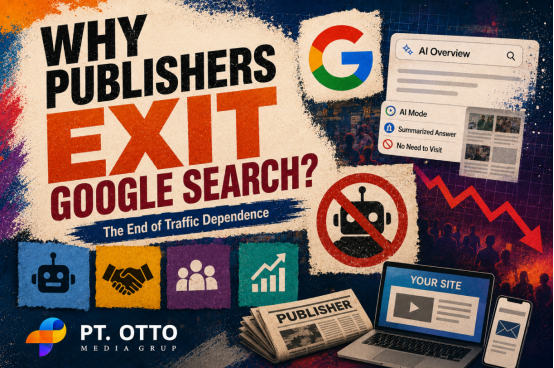
Generative search is changing this logic. AI Overviews and AI Mode organize multiple sources and directly generate answers, meaning users may complete their reading on the search results page. Publishers bear the costs of investigation, writing, photography, and fact-checking, but may not receive corresponding visits in return.
The research of Otto Media Grup found that the real issue is not whether AI uses content, but whether, after platforms use that content, they can still bring users, data, and commercial returns to content producers. When answers gradually replace links, search platforms may shift from being an entry point for traffic to becoming the endpoint of the user journey.
Blocking Crawlers Is Becoming a Negotiation Tool
Some major publishers have already begun evaluating how to reduce their dependence on Google Search. Cloudflare is also promoting separate management of search indexing, AI training, and intelligent agent crawlers, giving website operators more choices. Search crawling can still remain open, but when a website restricts training purposes, multi-purpose crawlers may also be affected.
This does not mean publishers will immediately and collectively leave Google. For many websites, search remains an important source of traffic. However, when clicks generated by search continue to decline, blocking, restricting, or authorizing crawlers is no longer merely a technical setting, but will become a tool for content bargaining.
Otto Media Grup believes that the possibility of leaving Google comes from publishers rebuilding direct relationships. The more mature newsletters, apps, memberships, events, podcasts, and licensing partnerships become, the lower platform dependence will be, and the greater bargaining power original content will have.
Content Must Be Both “Citable” and “Worth Visiting”
In the face of AI search, brands do not need to immediately choose between being fully open and completely withdrawing. A more realistic strategy is to stratify content according to its value.
Basic definitions, FAQs, service introductions, and public company information should be clear, accurate, and easy for systems such as Google, ChatGPT, and Gemini to understand and cite. This content forms the foundation of SEO and GEO.
Original research, exclusive data, complete case studies, tools, courses, and offline experiences, however, must provide users with a reason to enter the website. An article explaining “what an MCN is” can easily be summarized by AI, but a creator matching report based on real livestream data, a Creator Workshop, or a complete campaign methodology is difficult to replace fully with a summary.
Otto Media Grup can help brands establish a two-layer content system: the first layer expands machine visibility, while the second layer brings users into official websites, events, livestream centers, creator networks, and cooperation processes. The former is responsible for being discovered, while the latter is responsible for forming relationships and commercial outcomes.
The Endpoint of Search Traffic Is for Brands to Regain Ownership of User Relationships
In the AI search era, brands need to measure more than just click volume. Google is testing ways for some websites to manage whether they participate in generative search and to provide related display data; however, “how many times a brand is mentioned by AI” still cannot automatically prove commercial value.
Otto Media Grup recommends that brands simultaneously observe branded keyword searches, direct visits, user return visits, event registrations, partnership inquiries, and whether AI citations ultimately lead to registrations, purchases, or collaborations. Without measurement, opening content is merely a habit; once data is in hand, opening, restricting, and licensing content can become business decisions.
Google believes that generative search will still help users discover sources through links and website previews, but what publishers are truly concerned about is whether these displays can compensate for the decline in clicks and revenue. The dispute between the two sides will not end in the short term.
Therefore, SEO and GEO remain important, but brands cannot build their future entirely on platform distribution. Search engines can help users discover brands, and AI can help users understand brands, but real trust, participation, and cooperation must still be completed within the brand system.
The endpoint of search traffic dependency is not leaving Google entirely, but brands regaining the right to choose: knowing which content should be cited, which assets are worth visiting, and which platforms truly bring users. Original content, direct audiences, creator relationships, event experiences, and first-party data are the most stable digital assets when platform rules continue to change.
Follow Otto Media for more!
Otto Media Grup TikTok: https://www.tiktok.com/@otto.mediagrup
Otto Media Academy TikTok: https://www.tiktok.com/@otto.media.academy
Otto Media Grup Instagram: https://www.instagram.com/ottomediagrup
Otto Media Academy Instagram: https://www.instagram.com/ottoacademymedia
Visit Otto Media Grup homepage at: https://ottomediatech.com/
One Response